

Snowflake Placements

- Krishna
- June 18, 2024
- 11:48 am

Table of Contents
Snowflake Developer Salary in India
If you are learning Snowflake, almost everyone has one common doubt: “Are placements really strong?” You may see Snowflake job posts regularly on LinkedIn and other job portals. But what is the real situation in 2026? Can freshers directly get a Snowflake job, or is it more challenging than it looks? The simple answer is yes, Snowflake has good demand in the job market, but getting placed depends on your practical knowledge and preparation. It is not automatic. Instead of making assumptions, it is better to understand how placements actually work. In this article, let’s clearly discuss the real Snowflake placement scenario, how companies hire candidates, and what you should focus on to improve your chances.
How Is the Snowflake Placement Market in 2026?
In 2026, Snowflake continues to grow in popularity. More companies are using cloud platforms to manage and analyze their data.
The demand for Snowflake is increasing mainly because:
- Many companies are moving their data systems to the cloud.
- Businesses are handling larger amounts of data than before.
- Snowflake is widely used for data storage, analytics, and reporting.
- It allows companies to scale easily as their data grows.
- Organizations prefer modern data platforms over traditional systems.
Because of these reasons, hiring for Snowflake-related roles has gradually increased. Companies are actively looking for professionals who can work confidently with data in cloud environments.
How Companies Hire for Snowflake Roles
Different companies follow different hiring patterns for Snowflake roles. Here’s a simple comparison:
Company Type | Hiring Style | What They Focus On | Work Environment |
Service-Based Companies | Hire in bulk, especially for client projects | Ability to adapt and work in teams | Structured, project-driven |
Product-Based Companies | More selective hiring | Strong practical understanding and real project exposure | Quality-focused, stable |
Startups | Limited but flexible hiring | Problem-solving ability and multi-tasking | Fast-paced, high responsibility |
So, your placement experience may change depending on whether you apply to a service company, product company, or startup.
Do Freshers Have Real Placement Chances?
This is one of the biggest concerns for beginners. Many freshers wonder whether they can directly enter a Snowflake role after completing their training.
To be honest, getting a direct “Snowflake Developer” position as a pure fresher can be slightly challenging. Most companies prefer candidates who have some practical exposure or real project experience.
However, freshers still have good entry opportunities through:
- Data Analyst roles
- ETL or Data Support positions
- Junior Data Engineer roles
- Internship programs in data or cloud teams
These positions enable candidates to gain hands-on experience and understand real-world business scenarios.
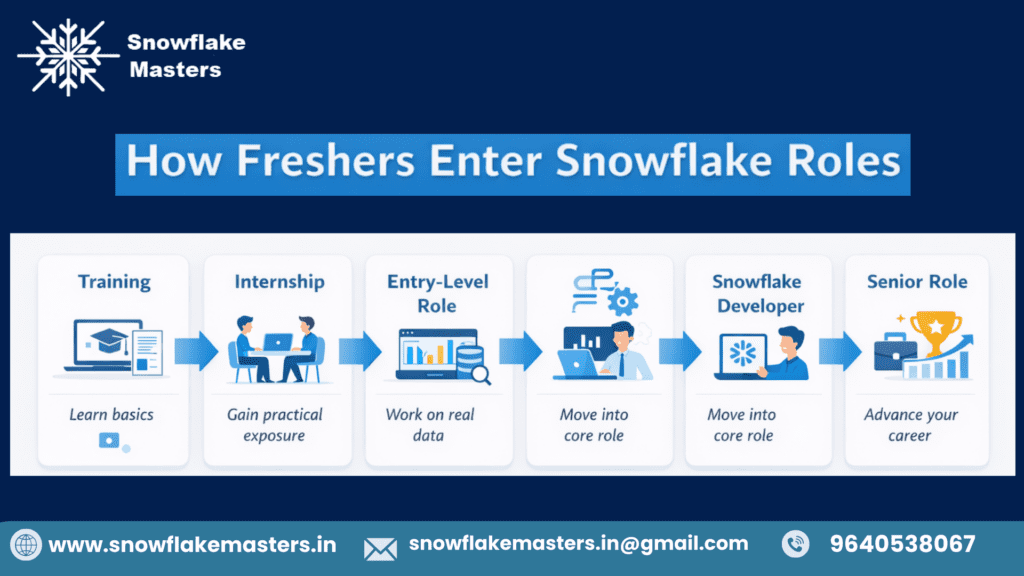
Another common and practical path is:
- Starting with an internship
- Performing well during the internship
- Converting it into a full-time role
Many companies prefer this approach because they can train candidates according to their project needs.
So yes, freshers do have real placement chances — but success usually depends on practical knowledge, consistency, and patience rather than just completing a course.
What Does the Snowflake Placement Process Look Like?
- Years of Experience:
More experience directly leads to higher pay. Professionals moving from 2 to 5 years of experience often see 40–70% salary growth, especially during job switches. - Company Type (MNC vs Startup vs Product Company):
Product-based companies and large MNCs generally offer 20–40% higher salaries compared to service-based firms. Startups may offer competitive CTC with performance-based components. - Location:
Major tech cities offer better pay due to higher demand and cost of living. Salaries can vary by 15–30% depending on the city. - Skill Stack Combination (SQL, Cloud Platform, ETL Tools):
Professionals skilled in SQL, cloud platforms (AWS/Azure/GCP), and ETL tools typically command higher packages than those with only basic database knowledge. - Certification Impact:
Relevant certifications can increase salary offers by 10–20%, particularly for professionals with less than 5 years of experience. - Domain Expertise (Banking, Healthcare, E-commerce):
Developers working in high-value domains like Banking, FinTech, or large-scale E-commerce often earn higher salaries due to complex data environments and business-critical systems.
In 2026, salary growth mainly depends on hands-on experience, a strong combination of technical skills, and the ability to manage complex, large-scale data projects effectively.
What Does the Snowflake Placement Process Look Like?
Once you apply for a Snowflake role, the placement process usually follows a few clear steps. It is not very complicated, but each stage is important.
In most cases, the process includes:
- Resume Shortlisting: Your resume is reviewed to check your project experience and relevant exposure.
- SQL-Based Technical Round: Many companies test your SQL knowledge and basic data concepts.
- Scenario-Based Questions: You may be asked how you would handle real data problems or performance issues.
- HR Discussion: If you clear the technical rounds, the final step is usually a discussion about salary, role, and joining details.
In most interviews, companies focus more on practical thinking and problem-solving ability than just theoretical knowledge.
The Reality of Institute Placement Support
You may often hear the phrase “100% placement support” in many places. However, it is important to understand what that actually means.
In the end, the final hiring decision is always made by the company. Institutes can provide training, guidance, resume support, interview preparation, and job referrals. But the job offer depends on how well the candidate performs in the interview process.
Placement support can open opportunities, but selection depends on practical knowledge, confidence, and preparation. So while training institutes play an important role in guiding students, consistent effort from the candidate is equally important.
How Can You Improve Your Snowflake Placement Chances?
Improving your placement chances does not require big changes. Small, consistent steps can create a strong impact over time.
Here is a simple action plan:
What You Should Do | Why It Matters |
Practice SQL regularly | Helps you perform better in technical interviews |
Build a clear resume | Makes your profile stand out during shortlisting |
Work on real-time projects | Shows practical understanding instead of just theory |
Stay active on LinkedIn | Increases visibility and job opportunities |
Attend mock interviews | Builds confidence and improves answer clarity |
When you consistently work on these areas, your placement chances naturally improve.
Common Mistakes Candidates Make During Placements
important mistakes. Understanding these can help you avoid them.
- Only relying on certification
Some candidates believe that completing a Snowflake certification is enough to get hired. However, companies focus more on practical knowledge and real project experience than just certificates. - Weak SQL fundamentals
SQL is a core skill in most Snowflake roles. If your SQL basics are not strong, clearing technical interviews becomes difficult. - Generic resume without projects
A resume that only lists tools without explaining real projects does not stand out. Recruiters look for practical exposure and clear contributions. - Not preparing for scenario-based questions
Many interviews include real-world problem questions. Without practicing these, candidates struggle to answer confidently. - Applying randomly without understanding the role
Applying to every job without reading the job description carefully reduces your chances. It is better to apply strategically.
Future Outlook of Snowflake Placements
Looking ahead, the future of Snowflake placements appears stable and promising. The technology continues to grow across industries, and its adoption is not slowing down.
Some key trends include:
- Snowflake adoption is still growing: More companies are choosing Snowflake as their primary cloud data platform.
- Cloud data roles are increasing: As businesses move to cloud systems, the demand for data professionals continues to rise.
- Long-term career stability: Snowflake skills are closely connected to data engineering and cloud technologies, which have strong long-term demand.
- Global demand trend: Snowflake professionals are not only in demand locally but also in international markets.
Overall, the outlook remains positive, especially for candidates who continuously upgrade their skills and stay updated with industry changes.
Conclusion
So, is Snowflake a good choice for placements? Yes, it can be — but you need the right expectations. There are good job opportunities in 2026, and many companies are hiring for cloud and data roles. At the same time, competition is also increasing, so just completing a course or getting a certificate is not enough. To improve your chances, you need regular practice, strong basics, real project experience, and confidence during interviews. If you stay consistent, keep learning, and prepare seriously, Snowflake can be a stable and rewarding career option in the long run.
FAQ’s
Yes, Snowflake has good demand in 2026 because many companies are using cloud-based data platforms. However, getting placed depends on your skills and preparation.
Direct Snowflake Developer roles for pure freshers can be slightly difficult. Many start with entry-level roles like Data Analyst or Support and then move into Snowflake roles.
No, certification alone is not enough. Companies mainly look for practical knowledge and project experience.
Service-based companies, product-based companies, startups, and MNCs hire Snowflake professionals based on their project needs. Hyderabad and Mumbai, due to strong hiring demand from tech and product companies.
The process usually includes resume shortlisting, technical interview (mostly SQL-based), scenario questions, and a final HR round.
It depends on your preparation level, project experience, and how actively you apply. Some candidates get placed within a few months, while others may take longer.
Yes, internships are very helpful. Many candidates start as interns and later convert to full-time employees based on performance.
Generally, service-based companies hire in larger numbers for client projects, while product-based companies are more selective.
SQL is very important. Most technical interviews test your SQL and data handling skills.
Yes, as long as cloud and data technologies continue to grow, Snowflake skills can offer stable career opportunities.