

Overview of Snowflake
Snowflake is a cloud-native data platform that enables organizations to store, process, analyze, and securely share data at scale. It runs on AWS, Microsoft Azure, and Google Cloud, offering high performance without the complexity of traditional data warehouses.

Introduction - Overview of Snowflake
Modern businesses generate massive amounts of data, and traditional data warehouses often fail to keep up. Snowflake solves these challenges with a cloud-first architecture:
- Scalability: Snowflake automatically scales storage and compute independently, so systems never slow down as data grows.
- Performance: Its multi-cluster architecture ensures fast query execution, even when multiple users run analytics at the same time.
- Cost Efficiency: With a pay-as-you-go model, organizations pay only for the resources they actually use—no expensive hardware or maintenance costs.
This makes Snowflake ideal for companies that need speed, flexibility, and predictable costs.
Why Students and Professionals Are Learning Snowflake Today
Snowflake is one of the most in-demand cloud data skills in the job market. Students and working professionals are learning Snowflake because it:
- Is widely adopted by global enterprises and startups
- Uses SQL, making it easy to learn even for beginners
- Integrates with AI, Machine Learning, and Data Science tools
- Opens doors to roles like Data Analyst, Data Engineer, BI Developer, and Cloud Architect
Learning Snowflake today means staying relevant in the fast-growing cloud and data analytics ecosystem.
What Is Snowflake?
Snowflake is a fully managed, cloud-native data warehousing platform built for high-performance analytics, elastic scalability, and secure data sharing.
It allows organizations to store and analyze massive datasets without managing infrastructure.
Key Characteristics of Snowflake
1. Cloud-Native Architecture
Snowflake is designed exclusively for the cloud, not adapted from old on-premise systems. This means:
- Faster performance
- Higher reliability
- Automatic scaling
- Zero hardware management
Because it’s cloud-native, Snowflake easily handles modern data types like structured, semi-structured, and unstructured data.
2. Separation of Storage and Compute
One of Snowflake’s most powerful features is its unique architecture:
- Storage and compute work independently
- Scale compute resources without affecting stored data
- Multiple teams can query the same data simultaneously
This eliminates performance bottlenecks and improves cost control, making Snowflake ideal for growing businesses.
3. Fully Managed Service
Snowflake takes care of all backend operations, including:
- Infrastructure setup
- Performance tuning
- Automatic scaling
- Security updates and maintenance
Users can focus on analyzing data instead of managing systems, which saves time and reduces operational costs.
4. Multi-Cloud Support (AWS, Azure, GCP)
Snowflake runs seamlessly on all major cloud platforms:
- Amazon Web Services (AWS)
- Microsoft Azure
- Google Cloud Platform (GCP)
This gives organizations the flexibility to choose their preferred cloud provider and avoid vendor lock-in.
Snowflake Architecture Explained Simply
Snowflake architecture is designed to be simple, scalable, and powerful. Unlike traditional data warehouses, Snowflake separates storage and compute, which makes it faster, more flexible, and cost-efficient.
Let’s break it down in an easy-to-understand way.
Three-Layer Architecture
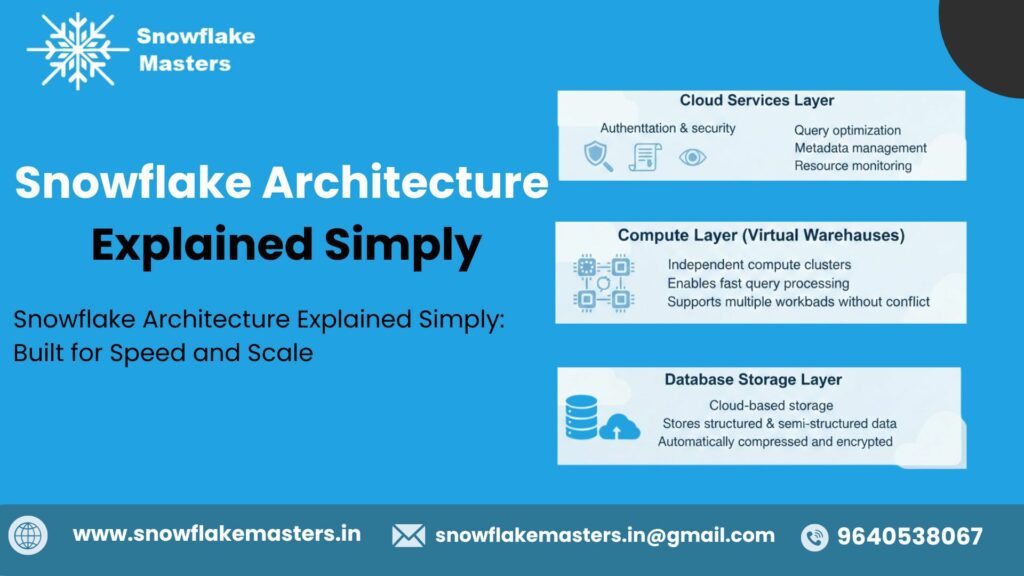
Snowflake follows a three-layer architecture, where each layer has a clear role and works independently.
1. Database Storage Layer
This is where all your data lives.
- Stores structured and semi-structured data (JSON, Avro, Parquet, ORC)
- Data is automatically compressed, encrypted, and optimized
- Users don’t need to manage files, indexes, or partitions
Simple explanation: Snowflake handles data storage for you securely and efficiently, without manual tuning.
2. Query Processing Layer
This layer is responsible for running your queries.
- Uses Virtual Warehouses (independent compute clusters)
- Each warehouse can be scaled up or down instantly
- Multiple teams can run queries at the same time without slowing each other down
Simple explanation: You choose how much computing power you need, and Snowflake processes your queries fast.
3. Cloud Services Layer
This is the brain of Snowflake.
- Manages authentication, security, metadata, and query optimization
- Handles workload management and transaction consistency
- Coordinates storage and compute layers seamlessly
Simple explanation: Snowflake’s cloud services layer automates everything behind the scenes so you can focus on data, not infrastructure.
Why Snowflake Architecture Is Different
- Independent scaling of compute and storage – Scale performance without increasing storage costs
- Zero infrastructure management – No servers, no hardware, no manual maintenance
- High concurrency with virtual warehouses – Multiple users and teams can query data simultaneously with consistent performance
Core Features of Snowflake
Snowflake is designed to make data analytics simple, fast, and intelligent. Its core features remove traditional data limitations while enabling advanced AI-driven insights for modern enterprises.
Essential Snowflake Features
Automatic Scaling
Snowflake automatically scales compute resources up or down based on workload demand.
This means you never face slow queries during peak usage—and you don’t pay for unused capacity during low usage.
Why it matters:
- Consistent high performance
- No manual resource management
- Ideal for growing businesses and enterprise workloads
Time Travel & Fail-safe
If data is accidentally deleted or changed, Snowflake makes it easy to recover it. The Fail-safe feature adds an additional layer of protection, ensuring data can still be restored in critical situations.
Why it matters:
- Protects against human errors
- Ensures data reliability
- Critical for compliance and auditing
Secure Data Sharing
Snowflake enables organizations to securely share live data across accounts, regions, and clouds—without copying or moving data.
Why it matters:
- Real-time data collaboration
- No data duplication
- Strong security and access control
This feature is widely used in data marketplaces and partner ecosystems.
Zero-Copy Cloning
Snowflake lets you create instant copies of databases, schemas, or tables without consuming extra storage.
Why it matters:
- Perfect for testing and development
- Faster analytics experimentation
- Reduces storage costs
Zero-copy cloning is a favorite feature among data engineers and analysts.
Snowflake AI Features
Snowflake goes beyond traditional analytics by embedding AI and machine learning directly into the data platform.
Snowflake Cortex Overview
Snowflake Cortex is Snowflake’s AI and ML layer, enabling users to build AI-powered applications directly on their data.
Key highlights:
- Large Language Models (LLMs) integration
- SQL-based AI functions
- No need to move data outside Snowflake
This makes AI adoption faster and more secure for enterprises.
Built-in ML and AI Capabilities
Snowflake provides native support for machine learning workflows, including data preparation, model training, and inference.
Key capabilities include:
- SQL and Python-based ML development
- Integration with popular ML frameworks
- Scalable model execution within Snowflake
This reduces dependency on external tools and speeds up AI projects.
AI-Powered Analytics for Enterprises
With AI-powered analytics, Snowflake helps businesses uncover patterns, predict outcomes, and automate decisions.
Enterprise use cases include:
- Customer behavior analysis
- Demand forecasting
- Fraud detection
- Intelligent reporting and insights
By combining data, analytics, and AI in one platform, Snowflake enables companies to move from data-driven to AI-driven decision-making.

Performance Optimization Techniques in Snowflake
Optimizing performance in Snowflake is essential to achieve faster query execution, lower costs, and better user experience. Below are the most effective and practical Snowflake performance optimization techniques used by data engineers and analytics teams.
Virtual Warehouse Sizing
Virtual warehouses control the compute power in Snowflake. Choosing the right size directly impacts query speed and cost.
- Start with a Small or Medium warehouse for development and testing
- Scale up warehouses for complex queries and heavy workloads
- Scale down or auto-suspend when workloads are idle to reduce costs
Best Practice: Use separate warehouses for ETL, BI, and ad-hoc analytics to avoid performance conflicts.
Query Pruning & Clustering
Snowflake automatically organizes data into micro-partitions, allowing it to scan only relevant data instead of full tables.
- Query pruning skips unnecessary partitions based on filters
- Clustering improves performance on large tables with frequent filter conditions
Use clustering keys for:
- Large tables (billions of rows)
- Queries that frequently filter on specific columns
Result: Faster query performance and reduced compute usage.
Result Caching
Snowflake automatically caches query results for 24 hours, eliminating the need to reprocess data.
- Repeated queries return results instantly
- No warehouse compute is used for cached results
- Cache is shared across users and sessions
Impact: Massive performance boost with zero additional cost.
Use of Materialized Views
Materialized views store precomputed query results, reducing processing time for complex analytics.
- Ideal for aggregation-heavy queries
- Automatically refreshed by Snowflake
- Improves dashboard and reporting performance
Use them wisely, as they consume additional storage and compute.
Snowflake Use Cases Across Industries
Snowflake is used across multiple industries because it can handle large-scale data, complex analytics, and real-time insights—all in one platform. Below are some of the most common and high-impact Snowflake use cases across industries.
Retail – Customer Analytics
In the retail industry, Snowflake helps businesses understand customer behavior and improve sales performance.
How Snowflake is used in retail:
- Analyze customer purchase history and preferences
- Track online and in-store behavior in real time
- Optimize pricing, inventory, and supply chain decisions
- Personalize product recommendations and offers
Business impact: Retailers can increase customer satisfaction, conversion rates, and revenue using data-driven insights.
Finance – Risk & Compliance
Financial institutions deal with massive volumes of sensitive data and strict regulations. Snowflake makes this process secure and efficient.
How Snowflake is used in finance:
- Monitor transactions for fraud detection
- Perform risk analysis and credit scoring
- Ensure regulatory compliance and audit reporting
- Securely share data across departments
Business impact: Faster risk assessment, improved compliance, and better decision-making with secure data access.
Healthcare – Patient Data Analytics
Healthcare organizations rely on Snowflake to manage and analyze complex patient and clinical data.
How Snowflake is used in healthcare:
- Store and analyze electronic health records (EHRs)
- Track patient outcomes and treatment effectiveness
- Support predictive analytics for disease trends
- Enable secure data sharing across hospitals and labs
Business impact: Improved patient care, operational efficiency, and data-driven medical decisions.
Marketing – Campaign Performance
Marketing teams use Snowflake to measure campaign success and optimize marketing strategies.
How Snowflake is used in marketing:
- Analyze multi-channel campaign performance
- Track customer journeys across platforms
- Measure ROI for digital ads and promotions
- Enable real-time reporting and dashboards
Business impact: Higher ROI, better audience targeting, and more effective marketing campaigns
Snowflake vs Traditional Data Warehouses
Choosing between Snowflake and a traditional data warehouse is a critical decision for modern businesses. Below is a clear, beginner-friendly comparison that explains why organizations are rapidly moving from legacy data warehouses to Snowflake.
Feature-by-Feature Comparison
Feature | Snowflake | Traditional Data Warehouses |
Scalability | Automatic scaling up or down based on workload | Manual scaling that requires planning and downtime |
Cost Model | Pay-as-you-go (pay only for storage and compute used) | Fixed licensing and infrastructure costs |
Maintenance | Fully managed by Snowflake (no servers to manage) | High maintenance effort (hardware, upgrades, tuning) |
Why Snowflake Is Better for Modern Businesses
- Automatic Scalability: Snowflake instantly adjusts resources when data volume or users increase. Traditional data warehouses require manual capacity planning, which often leads to over-provisioning or performance issues.
- Cost Efficiency: With Snowflake, businesses avoid heavy upfront investments. The pay-as-you-use pricing model is ideal for startups, growing companies, and enterprises. Traditional systems charge fixed costs even when resources are idle.
- Zero Maintenance Burden: Snowflake is a fully managed cloud service, handling backups, updates, security, and performance optimization automatically. Traditional data warehouses demand constant administrative effort from IT teams.
Business & Career Impact
- Businesses gain faster insights, lower costs, and operational flexibility
- Professionals benefit by learning a modern, in-demand platform used globally
In cities like Hyderabad, companies actively prefer Snowflake skills over legacy data warehouse experience
Career Opportunities with Snowflake
Demand for Snowflake Developers
The demand for Snowflake developers is growing rapidly as companies move their data to the cloud. Organizations across industries—IT, finance, healthcare, retail, and e-commerce—use Snowflake to manage and analyze large-scale data. Because Snowflake is cloud-native, scalable, and cost-efficient, businesses prefer it over traditional data warehouses. This has created a strong need for professionals who can design, build, and optimize data solutions using Snowflake.
Popular Job Roles in Snowflake
1. Data Engineer
Data Engineers use Snowflake to build and maintain data pipelines, manage data ingestion, and ensure high performance.
Key skills:
- Snowflake architecture
- SQL & performance optimization
- Data integration tools (ETL/ELT)
Why it’s in demand: Every data-driven company needs reliable and scalable data pipelines.
2. Analytics Engineer
Analytics Engineers bridge the gap between raw data and business insights using Snowflake.
Key skills:
- Advanced SQL
- Data modeling
- BI and analytics tools
Why it’s in demand: Companies want faster, accurate insights for decision-making.
3. BI Developer
BI Developers connect Snowflake with visualization tools to create dashboards and reports.
Key skills:
- Snowflake + Power BI / Tableau
- Query optimization
- Business reporting
Why it’s in demand: Executives rely on dashboards to track performance and growth.
Snowflake Salary Trends (India Context)
In India, Snowflake professionals are among the highest-paid data specialists:
- Entry-level: ₹6–10 LPA
- Mid-level (2–5 years): ₹12–25 LPA
- Senior/Architect roles: ₹30+ LPA
Salaries vary based on experience, certifications, cloud skills (AWS/Azure/GCP), and real-world project exposure.
Snowflake Placements & Job Market
Growing Demand in Hyderabad
Hyderabad is one of India’s fastest-growing cloud and data analytics hubs. Many companies are actively hiring Snowflake talent due to:
- Rapid cloud adoption
- Presence of global tech centers
- Strong startup ecosystem
Students and professionals trained in Snowflake find better Snowflake Placements opportunities in Hyderabad compared to many other cities.
MNCs & Startups Hiring Snowflake Professionals
Snowflake professionals are hired by:
- MNCs: Accenture, Deloitte, TCS, Infosys, Wipro, Cognizant, Capgemini
- Product companies and startups across FinTech, SaaS, and AI-powered analytics domains are actively hiring Snowflake professionals.
- Global enterprises: Using Snowflake for large-scale cloud data platforms
These companies look for candidates with hands-on Snowflake experience, strong SQL skills, and cloud knowledge.
Snowflake Training Roadmap in Hyderabad
Hyderabad is one of India’s fastest-growing hubs for cloud data engineering and analytics jobs. Companies are actively hiring Snowflake professionals with hands-on skills, not just theory.
Below is a clear, beginner-to-advanced Snowflake training roadmap designed specifically for learners in Hyderabad.
Recommended Learning Path
This structured roadmap helps students, freshers, and working professionals learn Snowflake step by step—without feeling overwhelmed.
Module | Key Topics Covered | Duration |
Basics | SQL fundamentals, Snowflake UI, Virtual Warehouses | Week 1 |
Core Snowflake | Snowflake architecture, storage layers, compute, security | Week 2 |
Advanced | Performance tuning, cost optimization, query optimization | Week 3 |
Projects | Real-time datasets, business use cases, end-to-end projects | Week 4 |
This learning path matches real industry requirements followed by companies hiring in Hyderabad.
Tools & Skills Covered
A good Snowflake training program in Hyderabad should focus on job-ready tools and practical skills, including:
Snowflake UI & CLI
Learn how to work with the Snowflake web interface and command-line tools to manage warehouses, databases, and workloads efficiently.
SQL Best Practices
Master optimized SQL writing, joins, window functions, and performance-friendly query patterns used in real projects.
DBT Training in Hyderabad (Analytics Engineering)
DBT is a must-have skill for modern analytics teams. You’ll learn how to:
- Transform data inside Snowflake
- Build analytics-ready models
- Follow analytics engineering best practices
SQL Training in Hyderabad (Foundational Skills)
Strong SQL is the backbone of Snowflake. This includes:
- Beginner to advanced SQL concepts
- Interview-focused SQL problems
- Real-world query scenarios
Learning Formats
Different learners prefer different styles. The best Snowflake courses in Hyderabad offer multiple learning formats:
Instructor-Led Training
Live sessions with industry experts who explain concepts clearly and answer real-time questions.
Snowflake Video Course
Snowflake Video Course Recorded lessons for flexible learning—ideal for working professionals and students.
Hands-On Projects
Work on real-time datasets such as sales, finance, healthcare, or marketing analytics to build confidence and portfolios.
Mock Interviews
Practice real Snowflake interview questions, scenario-based problems, and SQL challenges to crack Hyderabad-based job interviews.
Interview Preparation & Certification
Common Snowflake Interview Questions
Preparing for a Snowflake interview requires understanding both technical concepts and practical applications. Some frequently asked questions include:
- “What makes Snowflake unique compared to traditional data warehouses?”
- Explain Snowflake’s architecture (Database Storage, Compute Layer, Cloud Services).
- How do you optimize queries in Snowflake?
- What are Snowflake’s data sharing and cloning features?
- How does Snowflake handle semi-structured data like JSON or Avro?
These questions test your core knowledge of Snowflake features, cloud concepts, and SQL skills.
Real-World Scenario-Based Questions
Employers often ask scenario-based questions to see how you apply Snowflake in practical business situations. Examples include:
- How would you handle a large dataset with millions of rows that need real-time analysis?
- Explain how you would reduce compute costs for a company running multiple workloads simultaneously.
- Describe a situation where you used Snowflake’s data sharing or zero-copy cloning to improve team collaboration.
- How would you integrate Snowflake with BI tools like Tableau or Power BI for analytics?
Preparing answers to such scenarios shows your problem-solving skills and readiness for real-world projects.
Certification Benefits
Earning a Snowflake certification adds credibility and opens career opportunities, especially in regions like Hyderabad, where cloud and data analytics jobs are growing rapidly. Key benefits include:
- Enhanced employability – Certified professionals are preferred by top MNCs and startups.
- Career growth – Leads to roles like Data Engineer, Cloud Analyst, or Snowflake Consultant.
- Practical knowledge – Certification programs include hands-on labs and real-world projects.
- Higher salary prospects – Certified professionals often earn more than their non-certified peers.
Tip: Combine certification with real projects or internships in Hyderabad to maximize your career potential in cloud data analytics.
Conclusion : Overview of Snowflake
Snowflake is a cutting-edge, cloud-based data platform that empowers businesses to manage, analyze, and share data efficiently while reducing costs and improving performance. Its scalable, secure, and high-performance architecture makes it a future-proof solution for modern data challenges.
For learners and professionals, mastering Snowflake opens doors to in-demand careers in data analytics, cloud computing, and AI, especially in tech hubs like Hyderabad. Upskilling now ensures you stay ahead in the rapidly evolving data landscape.
Frequently Asked Questions
1. What is Snowflake used for?
Snowflake is used for cloud-based data storage, processing, and analytics. It helps businesses run fast queries, manage large datasets, and integrate with AI/ML tools efficiently.
2. Is Snowflake a database or data warehouse?
Snowflake is a cloud data warehouse, not a traditional database. It stores structured and semi-structured data and allows high-performance analytics at scale.
3. Why is Snowflake better than traditional data warehouses?
Snowflake offers scalability, cost-efficiency, and speed without hardware management. Unlike traditional warehouses, it separates storage and compute and supports multi-cloud deployment.
4. Is Snowflake good for beginners?
Yes! Snowflake is beginner-friendly. Its SQL-based interface and cloud-native design make it easy to learn for students and professionals starting with data analytics or cloud computing.
5. How long does it take to learn Snowflake?
Learning Snowflake basics can take 2–4 weeks with regular practice. Advanced skills, including data pipelines and Snowflake AI features, may take 2–3 months.
6. What skills are required to learn Snowflake?
Key skills include:
- SQL and data modeling
- Basic cloud computing knowledge (AWS, Azure, GCP)
- Understanding ETL/ELT processes
- Optional: Python or R for data analysis
7. Does Snowflake require coding?
Snowflake mainly uses SQL for querying. Coding in Python or Java is optional and only required for advanced analytics or integrating AI/ML pipelines.
8. What is Snowflake architecture?
Snowflake uses a unique multi-cluster, shared-data architecture:
- Database Storage Layer – Stores structured & semi-structured data
- Query Processing Layer – Handles computation via virtual warehouses
- Cloud Services Layer – Manages security, metadata, and transactions
9. What are Snowflake AI features?
Jobs in demand include Data Analyst, Data Scientist, AI/ML Engineer, Business Intelligence Specialist, Cloud Data Engineer, and AI Consultant, especially in organizations using cloud-based data platforms.
10. How does Snowflake improve query performance?
Yes. With the growth of AI, cloud computing, and data analytics, Indian companies across IT, finance, healthcare, and e-commerce are actively seeking professionals skilled in Snowflake AI features.
11. Can I learn Snowflake AI without coding?
Yes. Snowflake offers SQL-driven AI features and pre-built AI tools that allow users to perform data analytics and AI tasks without extensive coding knowledge.