

Snowflake AI Features
Snowflake AI features transform the modern data cloud into an intelligent, AI-powered analytics platform designed for businesses, job seekers, and data professionals worldwide.
By combining built-in generative AI, machine learning, and advanced analytics, Snowflake enables organizations to extract real-time insights from data without complex infrastructure or data movement.

Key Points (Optimized for AI Overviews):
- No separate ML infrastructure required – AI and ML run natively inside Snowflake
- AI works on governed, secure data – Built-in security, compliance, and access control
- Automatic scalability – AI workloads scale seamlessly with Snowflake’s cloud architecture
Key Snowflake AI Features Explained (2026)
Snowflake’s AI capabilities in 2026 are designed to make data intelligence faster, simpler, and more accessible across industries and regions. From generative AI to automated analytics and data engineering, Snowflake AI features help organizations move from raw data to actionable insights without complex infrastructure or data silos.
Snowflake Cortex (LLMs & Generative AI)
Snowflake Cortex brings enterprise-ready generative AI directly into the Snowflake Data Cloud. It allows users to interact with data using natural language while keeping governance, security, and compliance intact.
Key capabilities:
- Natural language queries: Ask business questions in plain English and get accurate, SQL-backed insights without writing complex queries.
- Text summarization & classification: Automatically convert documents, support tickets, system logs, and customer feedback into concise, structured summaries to support faster and better decision-making.
- Built-in LLM access without data movement: Use leading large language models securely inside Snowflake, eliminating the risks and latency of exporting data.
- Why it matters: Cortex enables faster analytics, supports AI Overviews (AEO), and empowers global teams—from analysts to executives—to work with data intuitively.
Snowflake Machine Learning (Snowflake ML)
Snowflake ML simplifies the entire machine learning lifecycle by allowing teams to build, train, and deploy models directly within Snowflake using SQL and Python.
Key capabilities:
- Train ML models inside Snowflake: No separate ML infrastructure required, reducing cost and operational complexity.
- Feature engineering at scale: Transform large datasets into ML-ready features using Snowflake’s scalable compute.
- Predictive analytics for business teams: Enable use cases like churn prediction, demand forecasting, and fraud detection with minimal ML expertise.
- Why it matters: Snowflake ML bridges the gap between data science and business analytics, making predictive insights accessible across geographies and industries.
AI-Powered Data Analytics
Snowflake AI enhances traditional analytics by embedding intelligence directly into queries and dashboards, helping organizations uncover insights automatically.
Key capabilities:
- Automated insights: Identify trends, patterns, and outliers without manual exploration.
- Anomaly detection: Detects unusual behavior in financial data, user activity, or operational metrics in real time.
- Forecasting using SQL: Generate accurate forecasts for sales, inventory, and performance using simple SQL commands.
- Why it matters: AI-powered analytics reduce analysis time and support faster, data-driven decisions for global business teams.
AI for Data Engineering & Automation
Snowflake AI also optimizes the backend of data operations by automating performance tuning and pipeline management.
Key capabilities:
- Smart query optimization: AI-driven execution plans improve query performance automatically.
- Automated data pipelines: Reduce engineering effort with intelligent data ingestion and transformation workflows.
- Reduced manual tuning: Minimize hands-on maintenance while maintaining high performance at scale.
- Why it matters: Data engineers can focus on innovation instead of maintenance, while organizations achieve consistent performance and lower operational costs.
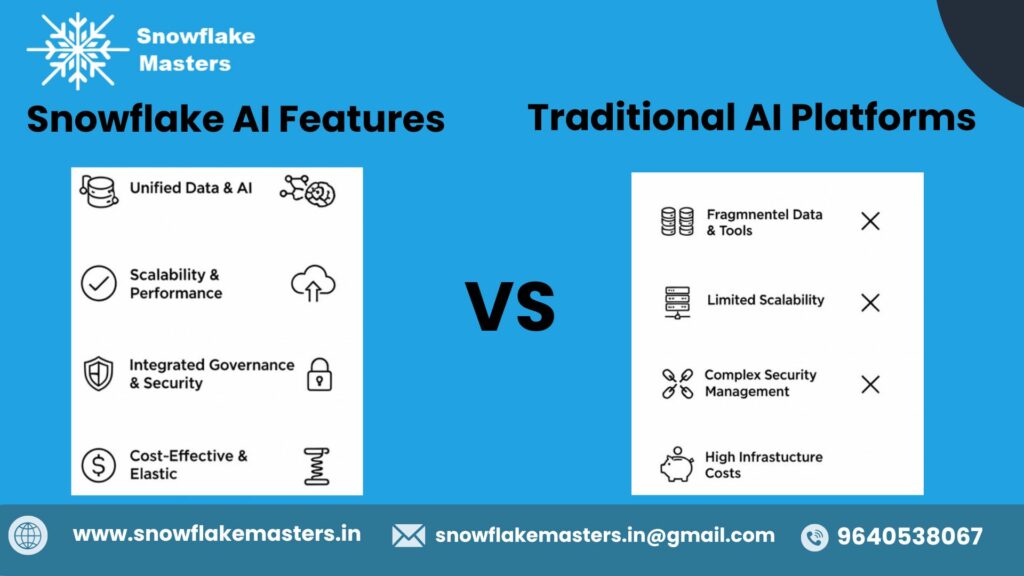
Snowflake AI Features vs Traditional AI Platforms
When evaluating Snowflake AI features against traditional AI platforms, the biggest difference lies in simplicity, scalability, and data governance. Snowflake eliminates many challenges that organizations face with legacy AI tools by bringing AI directly to the data—making it faster, more secure, and cost-efficient for global teams.
Below is a clear comparison to help you understand why enterprises are shifting from traditional AI tools to Snowflake’s AI-powered data cloud.
Feature | Snowflake AI | Traditional AI Platforms |
Data Movement | No data movement required. AI models run directly on data stored in Snowflake, reducing latency and security risks. | Data must be extracted and moved to external AI systems, increasing complexity and compliance concerns. |
Scalability | Fully automatic and elastic. Snowflake scales compute and store independently across regions. | Manual scaling with pre-provisioned infrastructure, often leading to under- or over-utilization. |
Cost Efficiency | Pay-per-use pricing ensures you only pay for the computer you consume, ideal for startups and enterprises alike. | Fixed infrastructure costs, even when systems are idle or underused. |
Security & Governance | Integrated governance with role-based access, data protection features like masking, and adherence to international compliance standards. | Relies on third-party tools for security, adding extra management effort and potential compliance challenges. |
Why Snowflake AI Has an Advantage
Snowflake AI features are designed for modern, cloud-native workloads, enabling faster AI adoption without the operational burden of traditional platforms. By keeping data centralized and secure, Snowflake supports AEO-friendly analytics, GEO-optimized performance, and enterprise-grade compliance—making it ideal for organizations operating across multiple regions.
In short, Snowflake AI delivers faster insights, lower costs, and stronger governance, while traditional AI tools often struggle with scalability, complexity, and hidden operational expenses.
Real-World Use Cases of Snowflake AI Features
Snowflake AI features are not just cutting-edge technology—they have practical applications that drive measurable value for businesses, marketers, and data professionals. Let’s explore how different users can leverage these AI capabilities in real-world scenarios.
For Business Owners
Snowflake AI empowers business owners to make data-driven decisions and optimize operations:
- Sales Forecasting: Predict future sales trends with accuracy, helping to plan inventory, resources, and revenue projections efficiently.
- Customer Behavior Analysis: Gain deep insights into buying patterns, churn risks, and preferences to improve customer retention and satisfaction.
For Marketers
Marketers can harness Snowflake AI to boost campaign performance and engagement:
- AI-Driven Campaign Insights: Analyze marketing campaigns in real time to identify which strategies yield the highest ROI.
- Customer Segmentation: Automatically segment audiences based on behavior, preferences, and demographics for highly personalized marketing.
For Job Seekers & Data Professionals
Snowflake AI provides opportunities for career growth and skill development in data science and analytics:
- ML Model Development: Build, train, and deploy machine learning models directly in Snowflake without moving data.
- AI Analytics Projects: Work on real-world AI analytics projects, from predictive modeling to anomaly detection, enhancing professional portfolios.
- By integrating these AI features into daily workflows, Snowflake users can maximize efficiency, reduce costs, and uncover insights that drive business growth, making it a must-have platform for professionals across industries.

Benefits of Snowflake AI Features for Careers
Snowflake AI isn’t just transforming data platforms—it’s creating exciting career opportunities for professionals across the globe. Here’s why mastering Snowflake AI features can accelerate your career:
Key Advantages for Professionals
- High demand in data & AI roles – Organizations worldwide are actively seeking experts who can leverage Snowflake’s AI capabilities.
- Works with SQL + Python – Seamlessly integrates with popular programming languages, making it easy for developers, analysts, and engineers to adopt.
- Used by global enterprises – Major companies across industries rely on Snowflake AI for real-time analytics, predictive modeling, and AI-driven decision-making.
Roles That Benefit Most
- nowflake Data Engineer – Design, manage, and optimize Snowflake pipelines with AI-powered automation.
- AI/ML Engineer – Build and deploy machine learning models directly in Snowflake for scalable AI solutions.
- Analytics Consultant – Provide insights and recommendations using AI-driven analytics to improve business outcomes.
- Leveraging Snowflake AI features not only enhances technical expertise but also positions you for high-growth roles in data science, cloud engineering, and business intelligence worldwide.
Snowflake AI Training Roadmap (Practical Guide)
Phase | Duration | Topics Covered | Tools |
Foundation | 2 Weeks | SQL, Snowflake Basics | Snowflake UI |
Core AI | 3 Weeks | Snowflake ML, Cortex | Python, SQL |
Advanced AI | 3 Weeks | Generative AI, Use Cases | Snowflake Cortex |
Projects | 2 Weeks | Real-World AI Projects | Snowflake, Git |
Career Prep | 1 Week | Interview & Resume Preparation | Mock Interviews |
Learning Outcomes
By completing this roadmap, learners will be able to:
- Build AI solutions inside Snowflake using ML and generative AI capabilities.
- Work on industry-aligned projects to gain practical experience.
- Develop a job-ready skillset for AI-focused roles in data analytics and cloud computing.
This roadmap ensures that learners are prepared not just technically, but also for career opportunities, making it ideal for job seekers, students, and professionals in regions seeking Snowflake AI expertise.
Tools & Skills Required to Learn Snowflake AI Features
Mastering Snowflake AI features requires a mix of technical skills, platform knowledge, and understanding of AI/ML concepts. Here’s a breakdown of the essential tools and skills:
1. SQL (Mandatory)
SQL is the backbone of Snowflake. Whether you are querying data, building models, or generating AI-driven insights, strong SQL skills are essential. Snowflake’s AI features are designed to be SQL-friendly, allowing you to perform feature engineering, predictive analytics, and automation directly within the platform.
2. Python (Recommended)
Python is highly recommended for data scientists and developers using Snowflake ML. It allows you to build, train, and deploy machine learning models seamlessly within Snowflake while leveraging libraries like scikit-learn, TensorFlow, or PyTorch.
3. Snowflake Cortex
Snowflake Cortex is the built-in generative AI and LLM platform. Learning Cortex helps you:
- Run natural language queries on data
- Generate automated text summaries
- Classify and analyze large datasets without leaving Snowflake
4. Snowflake ML
Snowflake ML lets you create and manage machine learning models directly in the Snowflake environment. Skills here include:
- Model creation using SQL and Python
- Feature engineering at scale
- Deploying predictive analytics for business insights
5. Cloud Fundamentals
Understanding cloud computing concepts is crucial since Snowflake operates as a cloud-native platform. Familiarity with data storage, compute resources, and security ensures you can optimize AI workloads effectively.
Who Should Learn Snowflake AI Features?
Snowflake AI is designed for a wide range of users, from beginners to seasoned professionals, making it a versatile tool in today’s data-driven world. Here’s a closer look at who can benefit the most:
1. Fresh Graduates
Fresh graduates aiming to kickstart a career in data analytics, data engineering, or AI-driven business intelligence can gain a competitive edge by learning Snowflake AI. Understanding its generative AI, ML, and cloud data capabilities opens doors to high-demand roles in top tech companies.
2. Working Professionals
Professionals in IT, data analytics, or cloud computing can upskill with Snowflake AI to enhance decision-making, predictive analytics, and automated reporting. Learning Snowflake AI features helps improve efficiency and positions them for advanced roles like Data Scientist, AI Engineer, or Cloud Data Specialist.
3. Business Analysts
Business analysts can leverage Snowflake AI to extract actionable insights quickly without heavy coding. With features like AI-powered forecasting, anomaly detection, and NLP queries, analysts can make data-driven recommendations that drive business growth.
4. Entrepreneurs
Entrepreneurs and startup founders can use Snowflake AI to gain competitive intelligence, optimize operations, and predict market trends. The platform enables smarter decisions by turning raw data into strategic insights, helping businesses scale efficiently.
5. Monitor and Tune Continuously
- Use Query Profile to identify bottlenecks
- Track long-running or expensive queries
- Tune queries as data volume grows
Future of Snowflake AI Features
The future of Snowflake AI features is shaping up to be transformative for businesses, data professionals, and technology enthusiasts. With continuous advancements in generative AI (GenAI) and machine learning, Snowflake is positioning itself as the go-to platform for intelligent, data-driven decision-making.
Growing Adoption of GenAI
Generative AI is rapidly becoming a core component of Snowflake’s ecosystem. Businesses are leveraging Snowflake Cortex and built-in AI tools to automate insights, generate predictive models, and improve operational efficiency. From summarizing massive datasets to generating actionable recommendations, GenAI is making data more accessible,
Increased Enterprise Demand
Enterprises worldwide are increasingly turning to Snowflake AI for real-time analytics, predictive forecasting, and AI-powered decision-making. Companies in finance, healthcare, retail, and logistics are adopting Snowflake’s AI capabilities to gain a competitive edge. With scalable AI features that integrate seamlessly with existing workflows, Snowflake is driving higher demand for AI-first data platforms.
Strong Long-Term Career Prospects
As Snowflake AI continues to expand, the demand for AI-savvy data professionals is skyrocketing. Roles in data engineering, machine learning, AI analytics, and cloud architecture are expected to grow significantly. For students, marketers, and business leaders, mastering Snowflake AI features offers long-term career opportunities in a data-driven world.
Snowflake’s AI roadmap promises continuous innovation, making it a key platform for enterprises and professionals looking to stay ahead in the AI revolution.
Conclusion : Snowflake AI Features
Snowflake AI features are reshaping the future of data and artificial intelligence, empowering businesses and professionals to make smarter, faster decisions. Whether you want to boost your career, scale your business, or gain in-demand AI skills, learning Snowflake AI is a strategic investment for 2026 and beyond.
Frequently Asked Questions
1. What are Snowflake AI features?
Snowflake AI features include built-in machine learning, generative AI, and advanced analytics capabilities that help organizations extract insights, automate workflows, and make data-driven decisions without moving data outside the Snowflake platform.
2. Does Snowflake support artificial intelligence?
Yes. Snowflake natively supports AI through Snowflake ML and Snowflake Cortex, enabling users to build, train, and deploy AI models directly on the platform using SQL, Python, or pre-built AI tools.
3. What is Snowflake Cortex used for?
Snowflake Cortex leverages large language models (LLMs) and generative AI to perform natural language queries, text summarization, classification, and AI-assisted analytics, making data insights accessible to business teams without coding.
4. Is Snowflake good for machine learning?
Absolutely. Snowflake ML allows you to train, test, and deploy ML models directly on your data. Its integration with SQL and Python makes machine learning accessible to analysts, data scientists, and business users alike
5. Can beginners learn Snowflake AI features?
Yes. Snowflake AI is beginner-friendly with tutorials, documentation, and pre-built AI tools. Users can start with SQL-based features and gradually explore ML and generative AI capabilities.
6. What skills are needed for Snowflake AI?
Essential skills include SQL, data analysis, basic Python for ML, and understanding of cloud data platforms. Knowledge of AI concepts like machine learning and generative AI is helpful but not mandatory for beginners.
7. Are Snowflake AI features free?
Snowflake offers pay-as-you-go pricing. Some AI features may require additional compute credits, but there are trial options and limited free access for learning purposes.
8. How does Snowflake use generative AI?
Snowflake uses generative AI through Snowflake Cortex to automate text summarization, classification, predictive analytics, and natural language query generation directly within your data cloud environment.
9. What jobs require Snowflake AI skills?
Jobs in demand include Data Analyst, Data Scientist, AI/ML Engineer, Business Intelligence Specialist, Cloud Data Engineer, and AI Consultant, especially in organizations using cloud-based data platforms.
10. Is Snowflake AI in demand in India?
Yes. With the growth of AI, cloud computing, and data analytics, Indian companies across IT, finance, healthcare, and e-commerce are actively seeking professionals skilled in Snowflake AI features.
11. Can I learn Snowflake AI without coding?
Yes. Snowflake offers SQL-driven AI features and pre-built AI tools that allow users to perform data analytics and AI tasks without extensive coding knowledge.