

Snowflake Roadmap 2026

- Krishna
- March 9, 2025
- 5:28 pm
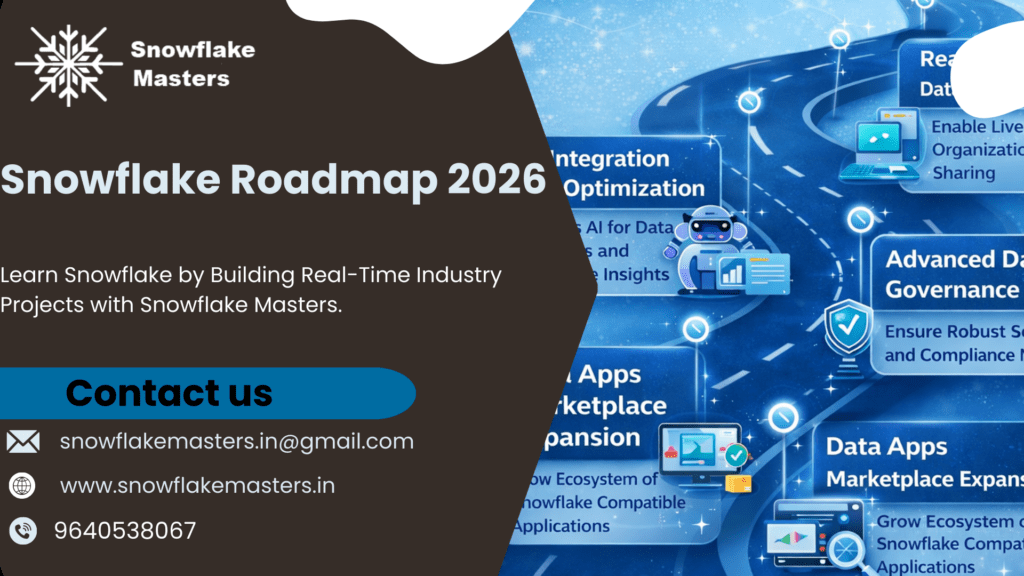
Table of Contents
Snowflake Roadmap 2026
A Snowflake roadmap is a clear learning path that helps you grow from a beginner to a job-ready professional. It starts with strong SQL fundamentals, since Snowflake works entirely on SQL. Once that foundation is solid, you move on to understanding Snowflake architecture, virtual warehouses, and how storage and compute are separated. The next step is hands-on practice with data loading, transformations, Time Travel, and Zero-Copy Cloning. As you advance, focus on performance optimization, security, roles, and access control, which are essential in real-world projects. Finally, adding certification and cloud fundamentals strengthens your profile. In simple words, this roadmap helps you build Snowflake skills step by step and become industry-ready with confidence when you choose the right Snowflake Training.
Snowflake Roadmap 2026: Structured Learning Path
This Snowflake Roadmap 2026 gives you a simple and clear step-by-step path to learn Snowflake the right way. If you follow each stage patiently, you can build strong skills without feeling overwhelmed or confused.
| Stage | What You Should Learn | Why It Matters in 2026 | What to Practice | Pro Tips (From Experience) |
| 1. Basics of Databases | SQL fundamentals, RDBMS concepts, normalization, joins, indexing | Snowflake is SQL-based. Without strong SQL, nothing works smoothly. | Practice SELECT, JOIN, GROUP BY, subqueries in MySQL/PostgreSQL | Don’t rush Snowflake directly. Strong SQL = 50% success already. |
| 2. Cloud Fundamentals | Basics of Cloud Computing, SaaS, IaaS, PaaS | Snowflake is fully cloud-based. Understanding the cloud makes architecture easier. | Learn the basics of AWS S3, Azure Blob, or GCP Storage | You don’t need to master AWS — just understand how storage works. |
| 3. Snowflake Architecture | Virtual Warehouses, Databases, Schemas, Micro-partitions, Cloud Services Layer | Interviewers LOVE architecture questions in 2026 | Create multiple warehouses and test scaling | Understand compute vs storage separation clearly — very important. |
| 4. Snowflake SQL & Data Loading | COPY INTO, Stages (Internal & External), File formats, Data types | Real projects revolve around loading and transforming data | Load CSV & JSON files from S3 into Snowflake | Practice error handling while loading files — a very practical skill |
| 5. Performance Optimization | Clustering Keys, Query Profile, Caching, Warehouse Sizing | Companies focus on cost optimization in 2026 | Analyze slow queries and optimize them | Always check the Query Profile before scaling the warehouse blindly |
| 6. Snowflake Security | Roles, RBAC, Data Masking, Row-level security | Data privacy laws are strict now | Create custom roles and test access control | Learn how ownership works — many beginners confuse this |
| 7. Snowflake Data Sharing | Secure Data Sharing, Reader Accounts | Very important for enterprise data collaboration | Create a sample sharing environment | Data Sharing is Snowflake’s biggest USP — understand deeply |
| 8. Snowpark & Advanced Features | Snowpark (Python/Java), UDFs, Stored Procedures | 2026 trend: More data engineering + ML integration | Build a small transformation using Snowpark Python | If you know Python already, Snowpark will boost your profile |
| 9. Integration Tools | Integration with Power BI, Tableau, dbt, Airflow | Snowflake alone is not enough — ecosystem knowledge matters | Connect Snowflake with a BI tool | Learn DBT + Snowflake combo — high demand skill |
| 10. Real-Time & Advanced Topics | Streams, Tasks, Time Travel, Fail-safe | Used in production systems | Build simple incremental pipeline | Streams + Tasks are common interview questions |
Why This Snowflake Roadmap Matters in 2026
In 2026, learning Snowflake randomly is not enough. The industry expectations have changed, and companies now look for structured, practical expertise. Here’s why this roadmap truly matters:
- Cloud-First Companies: Most organizations now operate entirely on cloud infrastructure. Snowflake works natively in the cloud, so understanding cloud concepts and architecture is essential, not optional.
- Cost Optimization Importance: Snowflake uses a consumption-based pricing model. Poorly written queries or improper warehouse sizing can increase costs quickly. Companies expect professionals who can optimize performance and manage compute efficiently.
- Security & Compliance Requirements: With strict data privacy regulations, businesses need strong role-based access control, data masking, and governance strategies. Security knowledge is now a core skill.
- Real-World Project Expectations: Employers want hands-on problem solvers who can build pipelines, manage incremental data loads, and integrate Snowflake with BI tools.
- Structured Learning Over Random Learning: A roadmap ensures you build skills in the correct order. Instead of confusion, you gain clarity, confidence, and industry-ready expertise.
How to Follow the Snowflake Roadmap Step by Step
A roadmap works only when you follow it with discipline. Instead of jumping between topics, move through phases and focus on mastering one layer at a time.
Phase | Focus Area | Main Goal |
Weeks 1–2 | SQL Fundamentals & Database Basics | Build strong query-writing confidence |
Weeks 3–4 | Snowflake Architecture & Data Loading | Understand compute-storage separation and load data correctly |
Weeks 5–6 | Transformations, Performance & Security | Optimize queries and implement role-based access control |
Weeks 7–8 | Advanced Features & Mini Projects | Build incremental pipelines using Streams and Tasks |
Theory vs Practice Balance
Follow a 40:60 approach — spend 40% of your time understanding concepts and 60% practicing in Snowflake. Real confidence comes from hands-on work.
When to Attempt Certification
Plan certification only after completing at least one end-to-end project and feeling comfortable with architecture, optimization, and security topics.
Project Building Order
Start with simple data loading, move to transformation workflows, and finally build an incremental pipeline. This gradual progression builds real-world readiness without confusion.
Snowflake Roadmap in Real Projects
Learning Snowflake becomes powerful only when you apply it to real scenarios. Instead of random practice, follow a structured project-based approach.
Sample Mini Projects
- Sales Data Warehouse Project: Load CSV sales data into Snowflake, create fact and dimension tables, and generate aggregated reports.
- E-commerce Analytics Project: Ingest customer and order data, build transformation queries, and create business-ready views.
- Role-Based Access Control Setup: Implement different roles (Admin, Analyst, Viewer) and test data-level permissions.
- Performance Optimization Case Study: Identify slow queries using Query Profile and optimize warehouse usage.
Dataset Practice Ideas
Use publicly available datasets like:
- Retail sales data
- COVID or healthcare datasets
- Financial transaction records
- Open government data
Working with real datasets improves your problem-solving ability and prepares you for interviews.
Incremental Learning Examples
Start by loading static data. Next, simulate daily data updates using Streams and Tasks. Finally, build a small automated pipeline that processes new records incrementally. Consistent hands-on practice like this makes your Snowflake skills practical, not just theoretical.
Common Mistakes to Avoid While Following the Snowflake Roadmap
Even with a clear Snowflake Roadmap 2026, many learners slow down their progress by making avoidable mistakes. Being aware of them can save you time and confusion.
1. Skipping SQL Fundamentals
Some learners jump directly into Snowflake without building strong SQL basics. Since Snowflake runs entirely on SQL, weak query-writing skills will create problems later, especially during interviews and real projects.
2. Jumping to Advanced Topics Too Early
Topics like Snowpark, Streams, and Tasks look exciting. But starting with advanced features without understanding the architecture and data loading creates knowledge gaps. Always build layer by layer.
3. Ignoring the Cost Model
Snowflake follows a usage-based pricing model. If you don’t understand warehouse sizing and query optimization, you may develop inefficient habits that are unacceptable in real projects.
4. Practicing Without Real Datasets
Only reading documentation or watching tutorials is not enough. Without hands-on practice using real datasets, concepts remain theoretical. Avoiding these mistakes keeps your learning structured, practical, and industry-focused.
Who Should Follow This Snowflake Roadmap?
This Snowflake Roadmap 2026 is designed for anyone who wants structured, step-by-step clarity instead of random learning.
- Beginners: If you are starting from scratch and want a clear direction without confusion, this roadmap gives you a proper foundation from SQL to advanced features.
- Data Engineers: Professionals who already work with data but want to transition into cloud-based platforms can use this roadmap to strengthen architecture, performance, and security skills.
- Career Switchers: If you are moving from another IT domain or database background, this structured path helps you reskill efficiently and avoid unnecessary topics.
- BI Professionals: Analysts and BI developers who work with reporting tools can use this roadmap to understand backend data processing and improve their technical depth.
Conclusion
Mastering Snowflake in 2026 is not about learning everything at once; it’s about learning the right things in the right order. A structured Snowflake Roadmap 2026 gives you clarity, direction, and confidence as you move from SQL fundamentals to architecture, data loading, optimization, and advanced features. When you follow a step-by-step approach and practice consistently with real-world scenarios, your skills become practical and industry-ready. Stay focused, avoid shortcuts, and keep building layer by layer. With steady effort and hands-on experience, you can confidently develop strong Snowflake expertise and prepare yourself for real data-driven challenges.
FAQ’s
It is a structured learning path that guides you step by step from SQL basics to advanced Snowflake features.
On average, it takes around 8–12 weeks with consistent practice.
Yes, strong SQL fundamentals are essential because Snowflake works entirely on SQL.
Basic cloud concepts are recommended since Snowflake is a cloud-based platform.
The first step is mastering SQL fundamentals and database basics.
After SQL basics, you should focus on understanding Snowflake architecture and virtual warehouses.
Yes, it includes stages, file formats, and the COPY INTO command for data ingestion.
Yes, query profiling, clustering, and warehouse sizing are important stages.
Yes, roles, RBAC, and access control are key components.
After completing core concepts and data loading, you can move to advanced features.